Books I'm Reading has become Books Worth Reading at www.reneamac.com. (Look for it in the categories on the left-hand side.)
Come join the discussion!
Sunday, September 20, 2009


Tuesday, June 9, 2009
Messy Spirituality: God's Annoying Love for Imperfect People

Messy Spirituality is about exactly that. It's a story of and a guide to rightly rejecting neat, sanitized spirituality, breaking out of the plastic shrinkwrap of systemitized religion, and embracing abundant life with all it's messes, failures, complexities, questions, joys, triumphs, tensions, paradoxes... which requires us to embrace grace. It requires the sometimes desperate acknowledgement of our constant need of grace, which turns us into people of Grace---the people we're all supposed to be from Eden, people of God.
Romans 12:2 warns against allowing the world to squeeze us into a particular pattern, a box that doesn’t let the Light in and keeps us from real living. Yaconelli recognizes that we’re not only in danger of the world trying to make us into what the world wants us to be: well-meaning Christians and churches often squeeze everybody into one-size-fits-all patterns of spirituality. This small book says big things about what it means to be spiritual and to walk with God.
Messy Spirituality derives from Yaconelli's own journey from legalism to liberty and the years of experience he has as a pastor of a small fellowship full of misfits. Jesus calls us to live faith-full lives. But too often we live fear-full lives. We're called to be radically different (as opposed to merely civily different). Yaconelli helps us think through these things, and he does so with patience and humility, humor, earthy-ness, wisdom, and love.
Romans 12:2 warns against allowing the world to squeeze us into a particular pattern, a box that doesn’t let the Light in and keeps us from real living. Yaconelli recognizes that we’re not only in danger of the world trying to make us into what the world wants us to be: well-meaning Christians and churches often squeeze everybody into one-size-fits-all patterns of spirituality. This small book says big things about what it means to be spiritual and to walk with God.
Messy Spirituality derives from Yaconelli's own journey from legalism to liberty and the years of experience he has as a pastor of a small fellowship full of misfits. Jesus calls us to live faith-full lives. But too often we live fear-full lives. We're called to be radically different (as opposed to merely civily different). Yaconelli helps us think through these things, and he does so with patience and humility, humor, earthy-ness, wisdom, and love.
Saturday, May 30, 2009
Phantom Island: Wind
 Krissi Dallas has hit the road running with her debut novel, Phantom Island: Wind. It instantly found its way to the number one selling spot at Authorhouse.com as the word-of-mouth buzz about this page-turner spread like wild fire surrounding the novel's release. The novel is Young Adult fiction; it's full of drama, adventure, suspense, and romance. As a vested seventh and eighth grade teacher and the wife of a youth pastor, YA fantasy-fiction is something Krissi Dallas is an expert on and has a passion for. Her love and affinity for her students, as well as the openly autobiographical nature of much of the book, have allowed Dallas to "open a vein," and write from the depths of who she is, from the heart. This deep connection transfers itself to the reader. I found myself desperately curious; no, not just curious, committed and concerned about the characters. Reading until the end of the chapter wasn't enough: I had to find out what would happen next and would they be okay. I don't think I have ever read a book this size this quickly---not even any of the Harry Potter series... which I also toted obsessively wherever I went so I could read every chance I got.
Phantom Island: Wind is divided into three parts, and it's part two that really gets you. If you weren't addicted already in part one, you definitely will be when part two begins. This is also where the fantasy part of this fantasy-fiction novel really kicks in. You know how you can tell when you're reading really good fantasy-fiction? When you can't tell. If you ever find yourself questioning the reality the author's created, it isn't good fantasy-fiction. While reading Wind I never once caught myself raising my eyebrow thinking, I don't know about that. I was completely engrossed.
Wind is well written. Dallas has a captivating command of detail. Good literature is good literature, regardless of the target audience. Phantom Island isn't just for teenagers; it's for anyone who hasn't forgotten how to read -- how to imagine and empathize and create. The plot and character development; the intrigue, the tension, the romance, the journey, the discovery; every thing about the Island kept me turning pages when I should have been sleeping.
Wind is the first book in the Phantom Island series. Water, is scheduled to come out Summer 2010. It's always nice to have something to look forward to, especially the "small" things; I can't wait to find out what happens next. For more about Phantom Island visit http://www.krissidallas.com/.
Friday, May 1, 2009
The Jesus Storybook Bible

I am so excited about this. It just came in the mail from Amazon, and I have been bringing it with me everywhere I go like show-and-tell because I am that pumped about it. Here's the thing; I started thinking about my first-graders and how I'd love to simply read a chapter book to them from week to week rather than individual stories. That got me to wondering if such a thing existed: a chapter-book version of the Bible. In my search, I stumbled across The Jesus Storybook Bible, which is pretty close. I love the byline: "Every story whispers his name." Every story in the Bible (even the Old Testament ones) whisper the name of Jesus, even all of the best faerie-stories we read in books and see in movies echo Jesus' story.
Listen to this excerpt from the introduction: read it out loud; it was meant to be read aloud:
No, the Bible isn't a book of rules, or a book of heroes. The Bible is most of all a Story. It's an adventure story about a young Hero who comes from a far country to win back his lost treasure. It's a love story about a brave Prince who leaves his palace, his throne -- everything -- to rescue the one he loves. It's like the most wonderful of fairy tales that has come true in real life!
You see, the best thing about this Story is -- it's true.
There are lots of stories in the Bible, but all the stories are telling one Big Story. The Story of how God loves his children and comes to rescue them.
It takes the whole Bible to tell this Story. And at the center of the Story, there is a baby. Every Story in the Bible whispers his name. He is like the missing piece in a puzzle -- the piece that makes all the other pieces fit together, and suddenly you can see a beautiful picture.
And this is no ordinary baby. This is the Child upon whom everything would depend. This is the Child who would one day -- but wait. Our Story starts where all good stories start. Right at the very beginning...
I'm impressed by the style and the quality of the writing and the art in this Bible. I'm impressed by the author's use of punctuation and parallelism and alliteration to make the story come to life. I'm impressed by the way she introduces ideas like God's "Never Stopping, Never Giving Up, Unbreaking, Always and Forever Love," ideas like Home (and ontology), Good and Evil, and the Creation-Fall-Redemption narrative. Sally Lloyd-Jones acknowledges Tim Keller for "giving [her this] vocabulary of faith." I'm impressed by that too. It sounds a bit high-faluting when it's described by how it has impressed me; but I promise you, it is not. It's a children's book that young children can read themselves and enjoy. But like any good children's literature, it's a good read for adults too.
Literally every story in this Bible from Genesis to Revelation hints at Jesus, speaks to the Logos, the Center of God's Story (and ours). This children's Bible is creative; it's fresh; it's intellectually ingenuous. It's what we've been waiting for.
Literally every story in this Bible from Genesis to Revelation hints at Jesus, speaks to the Logos, the Center of God's Story (and ours). This children's Bible is creative; it's fresh; it's intellectually ingenuous. It's what we've been waiting for.
The Jesus Storybook Bible isn't a replacement for your Children's NIV, but it's a good place to start, and a good supplement --- for your personal Bible reading as well as your children's.
Monday, February 23, 2009
Real Sex
 Lauren Winner, author of Girl Meets God and recently, Mudhouse Sabbath, put out a book in 2005 titled, Real Sex: The Naked Truth about Chastity. And that’s exactly what Winner designs to do: talk about sex in a realistic fashion, from a biblical worldview, that allows us to get past various myths, including the highly eroticized and romanticized beliefs on sex we frequently absorb from both the world and the church.
You’re familiar, no doubt, with the statistics on Christian sexuality. We don’t stand out as very different in our sexual behavior, which means our basic beliefs and ideas about sex must not be that different either. If all those books in the “Christian living” section of the bookstore aren’t helping us develop ideas regarding our sexuality that differ from social norms; if they aren’t helping us believe that what the Bible has to say about sex is relevant and true, something isn’t right. So what makes Winner different? Real Sex offers an alternative to the magazine-like “Seven Secrets to Sexual Purity” by stretching beyond spoon-fed “dos and don’ts” derived from proof-texting Scripture, and instead, presents the case for sex within marriage from a holistic, biblical view of who we are and how we relate in the world sexually.
From the creation-fall-redemption narrative presented in the Arc of the Gospel, Winner posits an important part of who we are is that we are embodied, and the main way in which we relate in the world sexually is communal. Chapter three is aptly titled, “Communal Sex: Or, Why Your Neighbor Has Any Business Asking You What You Did Last Night,” and helps remind us that community is a part of the creational order; we were created in and for community. And though we have fallen from God’s original order for creation, he has, throughout history, made a way for his people to live redeemed, creational lives. When Jesus Christ came embodied to earth, he came as the Way, finally making it possible for those who believe to no longer live under compulsion of the fallen, distorted patterns of the flesh, but rather in habits redeemed and restored to God’s creational intent. Winner reminds us that Scripture flies in the face of our over-individualized, over-privatized American way, exhorting the community of the faith to be intimately involved in one another’s lives. She puts it this way:
… the Bible tells us to intrude – or rather, the Bible tells us that talking to one another about what is really going on in our lives is in fact not an intrusion at all, because what’s going on in my life is already your concern; by dint of the baptism that made me your sister, my joys are your joys and my crises are your crises. We are called to speak to one another lovingly, to be sure, and with edifying, rather than gossipy or hurtful, goals. But we are called nonetheless to transform seemingly private matters into communal matters. (53)Already we’re presented with a meaty alternative to the false views of sex, or we could say, unreal sex propagated in force by our surrounding culture. The next two chapters speak truth against the lies about sex we hear both from our culture, and some of our churches. These chapters give readers an opportunity to take a step outside of their everyday, cultural surroundings and consider them. An interesting untruth presented to us by our culture we may not have yet considered is that “sex can be wholly separated from procreation” (64). Only a person living in a cave could miss the church’s view on abortion; however, the debate on contraception isn’t quite as clear-cut. Nonetheless, one issue concerning the topic that should be clear-cut is the issue of God’s ultimate control and our joyful, even if also painful, submission. Put more clearly,
…if contraception invites us to be carefree [a potential benefit], it also encourages us to be people who think we can control and schedule everything, including the creation of our families, down to the month, down to the week. And, most important, it invites us to be people who have utterly separated sex from procreation. (65)Why is this a danger? Well, for one, the connection between sex and making babies keeps us from being wholly wrapped up in ourselves as lovers (66); it returns sex and marriage to its communal orientation. Real sex is always open, in a general sense, to the possibility of children (67), and understands that possibility as a part of God’s good creational plan.
Opening up the conversation of sex and our sexuality to the whole of Scripture and to our Christian communities is like opening the windows of a dark room. By this light we see other lies our culture tells about sex, and we can work together to begin rejecting such ideologies, establishing a core understanding of human sexuality that, in fact, stands apart; we can develop beliefs and habits of a sacred sexuality. Winner points out that society tells lies like cohabitation is a good practice-run (68), modesty doesn’t matter (71), and “good sex can’t happen in the humdrum routine of marriage” (77).
Of those three statements, which strikes you as most dangerous? We might think it’s the prolific idea of shacking up; and in fact, the church is usually pretty clear on its position regarding premarital sex and modest dress; however, I would like to suggest that a subtle distortion is always more dangerous than an obvious one. Winner agrees; she states,
Too often we assume that contemporary American sexual life is a one-dimensional world of licentious prurience. Yet it may be more important for contemporary Christian ethics to constructively engage secular romanticism than to righteously denounce sexual libertinism. It is, after all, pretty easy for us Christians to distinguish ourselves from the sex-is-recreation ethic. The real question is not whether we can counter the message that sex is just like racquetball, but whether we can also articulate a Christian alternative to the regnant ideal of sex as an otherworldly, illicit romance, an escape from quotidian, domestic life. (80)Sex isn’t meaningful because it’s an erotic escape from everyday realities. Rather, sex is meaningful because it’s real (81). And while romance is certainly appropriate, even important, as part of sustaining love, if it serves merely to compartmentalize our lives rather than integrate them, our lives will be less, not more, fulfilling.
This next chapter is perhaps where we get a bit more personal: “Straight Talk II: Lies the Church Tells about Sex.” In an effort to do right and protect the biblical ethic of sex within marriage, and with honorable intentions, “the church tells a few fibs of its own” (85). Winner chooses to discuss four of these fibs: “premarital sex is guaranteed to make you feel lousy” (85), “women don’t really want to have sex anyway” (90), “bodies (and sex) are gross, dirty, or just plain unimportant” (93), and finally, if we’ve gotten over Gnosticism, now we’re obsessed with technique (97), as obsessed as our secular counterparts.
I can’t talk about all of these ideas (and I wouldn’t want to give away the whole book!), but I want to address a couple of them. I’m sure some of you are thinking, “Doesn’t premarital sex make you feel lousy, full of guilt and regret? And if it doesn’t, shouldn’t it?” It’s possible there’s more truth in the second thought than the first one, because let’s face it, sex feels good, even sinful sex. If it didn’t, premarital sex would certainly be a lot easier to avoid. We wouldn’t need Winner’s book or any other book, not to mention the community of faith, the Bible, or the Holy Spirit for that matter –– at least, not insofar as we need them for our journey toward right-living (89). “What the church means to say,” posits Winner, “is that premarital sex is bad for us, even if it happens to feel great” (90).
But at least we’ve come to recognize that sex in marriage feels great and should feel great. And while it seems we may never be able to fully shake Gnostic parasites from the Gospel, I believe churches have generally come to embrace marital sex as good. However, the message from the pulpit can still be a bit confusing, especially for women. Winner notes a study of teenage girls which shows the “strongest predictor of teenage virginity” isn’t church involvement or the youth group, but team sports (18). That may seem obscure, but athletics teaches girls (and boys) something about bodies being good –– and useful for other purposes than sex. This is a message we aren't communicating well.
So what should we do? Have more church sports leagues? Maybe... but perhaps not. We can, however, begin to change the way we talk about sex and modesty. Personally, as a woman who grew up constantly hearing from youth group and other para-church media that my body was the vehicle of lust and destruction for young men everywhere, it took lots of time to unlearn negative associations about my body and become comfortable in my own skin, though perhaps less time than others; I played sports. This language isn’t only damaging to women. To suggest that men simply can’t help themselves is to suggest that men are less than human, or that they can experience the fruit of the Spirit in all areas but lust. It is essentially degrading to men to imply that men are animals and women are angels, that somehow women are morally superior to men, and therefore responsible for them (73). Certainly we are responsible to one another as brothers and sisters, but responsible for is another thing entirely.
The last few chapters of Winner’s book touch on topics such as kissing, pornography, and masturbation, and dish out practical, and I think rather good and helpful, ideas to guide us in practicing chastity within our caring, Christian communities. Winner reunites chastity with the other spiritual disciplines, and talks about what marriage, children, sex, and singleness teach the church, why each is important in God’s economy, an economy of repentance and forgiveness. Placing sexual purity back within a story that’s bigger than itself makes the issue of chastity important, rather than indifferent, and gives it meaning by giving it context.
Saturday, February 21, 2009
This is not a book.

I loved this film. Really, really loved it. It was written by the same guys who did The Matrix trilogy, which is perfect because the films were anime-inspired. Speed Racer didn't do so well in theaters; it didn't get very high reviews either -- which is why I wanted to give it a little love on my blog. The film is intense visually. I'm not sure what it would be like to see it on the big screen; maybe too much to appreciate. But I also think it's really cutting-edge stuff, artistically magical. Under-appreciated genius. I'm not a huge anime fan, but I'll tell you what I appreciated about this film. The layering, the blending, um, the racing! (I've never had such a craving for slick track go-carts; I had to really control myself as I drove home from my friends' house in Fort Worth.), the cars, the choreographed "car-fu," and, the visual image-layering -- oh, did I say that already; well, that just might have been my favorite part.
I've never seen the original cartoon, but I know enough about it to be able to tell when certain scenes and lines were paying tribute. Intuitively, the film seemed honorable; you know, the film had honorable intentions toward the original. The movie makes me want to see the original cartoon. The character development was quite good. The plot was great. I'm gonna buy the movie.
Sunday, January 11, 2009
Repenting of Religion
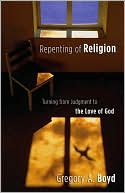 Hi all, John here. I read the book Repenting of Religion by Gregory A Boyd while at L'Abri this past summer. Here's my review:
From the back of the book: “Gregory A. Boyd is senior pastor of Woodland Hills Church in St. Paul, Minnesota. He is the author of twelve books, including Seeing Is Believing and the best-selling, Gold Medallion Book Award winner, Letters from a Skeptic.” If you have not read Letters from a Skeptic, I would also encourage you to read that. It is a conversation of letters between Boyd and his father, who was very anti-religion and anti-Christianity. That book is truly a picture of love and grace between son and father.
Repenting of Religion should become a very influential book in our postmodern times. It is one of the more impactful books that I have read in the past year. Published in 2004, it seeks to uncover and unpack what is wrong with the church today. Boyd begins by talking about the Tree of the Knowledge of Good and Evil. His take on it is that by eating of that Tree, we are now predisposed naturally towards judging others instead of loving them. And his take is that we are in reality, as a church generally (though not overall), still trying to earn our way into Heaven (my words) by the fact that we have set up hierarchies of sin and fail to love others.
He makes the point that churches today, like in the days of the Pharisees, are mostly not a place where broken, questioning, and lost people feel safe to come. They are not places where modern day “tax collectors”, prostitutes, and drug addicts, among others, feel free to come. Instead, they go to bars, pimps, drugs, and other addicts to feel loved. Is this right? Is this loving? Why, if we are called to love others like Christ, are these people not coming in? Boyd’s answer? Because we are failing to truly love.
The church as a whole has not failed to preach the message that salvation is by grace, not by works. Generally speaking, Christians don’t try to be saved by meticulously carrying out the Old Testament law. Yet we must wonder if we have adhered to the letter of Paul’s teaching and missed its spirit (2 Cor. 3:6). For as much as we claim that our relationship with God is based totally on the work of Christ, it seems that many of us nevertheless continue to try to get life from the rightness of our beliefs and goodness of our behavior. We continue to eat of the Tree of the Knowledge of Good and Evil, which the law, leading us to Christ, was meant to abolish…The fact that the collective body of the church (my note: Notice he didn’t call it the body of Christ!) is known more for its declarations of good and evil than for its outrageous love is telling. (pg 97)
He continues a little further down,
Another evidence of our spiritual pathology is that at both an individual and corporate level Christians often lack the freedom, flexibility, joy, boldness, and playfulness of a real lover. The abundant life and reckless love Jesus exemplified and came to bring is often replaced with a hypervigilance on what people ought to believe, how people ought to behave, and how the church should appear (emphases mine). We live out of our ethical maxims and religious ideas rather than the vibrant, concrete life and love of God. We live in the abstract, not the concrete.
This next section cuts to the core of the issue:
The New Testament is not about ethical behavior; it’s about a radical new way of
living. It is about life lived in surrendered union to God through faith in Jesus Christ. It is about experiencing the transforming power of God’s love flowing into and through a person. It demands a form of holiness that is far more exacting than any ethical or religious system. It demands a holiness of the heart that does not feed the fallen self by distancing itself from sinners but rather sacrifices itself to unite with sinners. This kind of holiness can never be achieved through behavior. It has to be received by grace (emphasis mine). Jesus’ ministry and the whole New Testament undermine our ethics and religion in order to position us to humbly receive this empowering and life transforming grace.
I remember reading an excerpt from Blue Like Jazz about a tent advertised as a “Confession Tent” that was set up on a widely secular, one that was almost semi-hostile to Christianity. When people entered that tent, instead of being encouraged to confess their own sins, the humble and repentant Christians inside instead confessed their often lack of love for others, lack of love for the world, lack of love for the campus. I think this is a beautiful example of the stance that Christians need to have at this time in history, one where we are on our knees, asking forgiveness for wrongs done in the past in the name of “Christianity” or “religion” that have hurt so many in unimaginable ways.
I am simply unable to do Boyd full justice of his work in this piece of writing, but I hope you, the reader, are beginning to understand Boyd’s premise that Christians have failed to love. We all fail to love recklessly, freely, without judgment.
I agree with Boyd that we need to quit judging and start living and loving. No more Christian bubble. No more putting certain sins on more of a pedestal than others. When we do that, we look down on others because we are in effect saying “Look, I don’t do these, and you do, so I’m better than you.” That easily leads into a spirit of judgment, the antithesis of love. When we fail to love, we fail to follow Christ. It’s that simple.
We are all sinners who need God’s grace. Let us look at the person, not the sin. Let’s love the person like Christ loved the prostitutes, the tax collectors, the sinners. Let us make our churches (as important as they are) places where everyone feels welcome. Let us love recklessly, painfully, sacrificially. Let us restore Christ’s good name on this Earth by living the loving life He calls us towards.
Until next time,
John
Friday, October 10, 2008
Living Apocalypse

Greg Laughery is the director of L'Abri Fellowship, a small English-speaking community nuzzled in the breathtaking Swiss Alps. It is a shelter and a home away from home for many, myself included. I spent the past year living and working at L'Abri and had the privilege to co-edit Dr. Laughery's latest book, Living Apocalypse. As a commentary on the book of Revelation, Living Apocalypse is highly accessible. It is not a book for the Bible scholar alone, although Bible scholars will not be bored. This commentary is beneficial to all. It is a relevant-to-life commentary, hence the title, but it isn't soft; it doesn't sacrifice hermeneutics.
If you find the book of Revelation intimidating or irrelevant, I encourage you to pick up Living Apocalypse and read it side-by-side with the text. Laughery helps his reader digest the biblical text passage by passage by providing the mainstream interpretations as well as his professional assessments. The symbolism in Revelation is perhaps what makes the text so highly difficult, which is why I find this book highly helpful. Laughery does an excellent job putting the Apostle's word-pictures into perspective by providing the historical context of John's time, the escatalogical application based upon the hermeneutic of the entire book, indeed the whole of Scripture, and the significance the text has for our everyday living.
It is this idea, aptly expressed by the title, that I like most about this book. The word 'living' serves both as an adjective and a verb. The Apostle John's Apocalypse is a living revelation, and as such, those who have been born again by and in the Word respond to his word by living it. Laughery encourages his readers that the book of Revelation is relevant to how we live our lives now. Again, this is what I find most valuable and most singular about Living Apocalypse. Greg Laughery's deep, genuine love and care for people is not only evident in his many years of service at L'Abri, it also manifests itself in his books. Living Apocalypse goes above and beyond the call of most commentaries by engaging the heart, as well as the mind. It connects the heart of the text to the heart of the reader, and thereby the heart of the reader to the heart of God -- having at its heart, a cyclical growth in mind.
If you find the book of Revelation intimidating or irrelevant, I encourage you to pick up Living Apocalypse and read it side-by-side with the text. Laughery helps his reader digest the biblical text passage by passage by providing the mainstream interpretations as well as his professional assessments. The symbolism in Revelation is perhaps what makes the text so highly difficult, which is why I find this book highly helpful. Laughery does an excellent job putting the Apostle's word-pictures into perspective by providing the historical context of John's time, the escatalogical application based upon the hermeneutic of the entire book, indeed the whole of Scripture, and the significance the text has for our everyday living.
It is this idea, aptly expressed by the title, that I like most about this book. The word 'living' serves both as an adjective and a verb. The Apostle John's Apocalypse is a living revelation, and as such, those who have been born again by and in the Word respond to his word by living it. Laughery encourages his readers that the book of Revelation is relevant to how we live our lives now. Again, this is what I find most valuable and most singular about Living Apocalypse. Greg Laughery's deep, genuine love and care for people is not only evident in his many years of service at L'Abri, it also manifests itself in his books. Living Apocalypse goes above and beyond the call of most commentaries by engaging the heart, as well as the mind. It connects the heart of the text to the heart of the reader, and thereby the heart of the reader to the heart of God -- having at its heart, a cyclical growth in mind.
Friday, September 19, 2008
Dangerous Wonder

Michael Yaconelli, or Mike as he likes to be called, is an unpretentious pastor of a small church in northern California who grew up under the oppression of legalism and has been fighting his way out since. He is the author of one of my all time favorite books, Messy Spirituality. Dangerous Wonder was written as somewhat of a followup, so I had to get my hands on it.
It would be years after I first bought Dangerous Wonder before I picked it up again to read it. Books do that to me. After waiting patiently among my other books for just the right time, they begin calling out to me. Sometimes in subtle ways through other things I'm reading or listening to; sometimes more directly and immediately as I stand before my bookshelf waiting and listening -- this is how it was with Dangerous Wonder, and when I took it from the shelf and sat down to read it, I finished it a few days later.
I enjoyed this inquiry into the "adventure of childlike faith." Yaconelli is honest and accessible, and in this book he uncovers the beauty of childlikeness: raw wonder, honest curiosity, wide-eyed listening, playfulness, passion, naive grace, and joy-filled terror.
Yaconelli desires to pull out all the stops; any encumbrance between his reader and childlikeness he wishes to remove, and as a result, you will find yourself (some of you more frequently than others) thinking, "But..." The author is prepared for this and addresses it outright with statements from time to time such as, "You might be saying to yourself, 'Wait a minute. You're not actually suggesting that I...'" (my paraphrase). And in response he says, "Go ahead, live irresponsibly! Forget about what is sensible, responsible and prudent and rediscover the childlike passion of falling in love with God" (118).
Though Yaconelli doesn't directly say it, it is this relationship with Christ that allows us to be irresponsible and yet thoughtful of the other. As I see it, such behavior is not irresponsibility; rather it is true responsibility, true responsiveness. In Christ we have a higher responsibility to God and man. Dangerous Wonder comes off as extreme and one-sided for this lack of emphasis on renewing what we think these ideas mean and because he ignores the person-relative aspect of living -- that is to say, the ways in which we draw such lines differently based on personality and personal history. And sometimes we need to be challenged to redraw those lines so that our framework encompasses more of what it means to live (abundantly), but other times our different boundaries are a beautiful part of our need for community in the body of Christ. Or possibly, these paths are not within the scope of this book. At any rate, I do not get the impression that Yaconelli misunderstands these aspects of the abundant life of childlike faith. In his soul he knows, even if perhaps immediate consciousness (what he would think to say right off) hasn't caught up to the deep knowledge.
Most importantly however, I think this is a valuable book. Childlikeness is essential, and it's beautiful. It's highly important to my generation's quest for authenticity because it is authentic. Dangerous Wonder is a challenge to its reader to develop inward sincerity through the liberating work of Christ's transformative way of being. Otherwise it is difficult, perhaps impossible to even know what to look for in an outward search for what's 'real' because we don't know what 'real' looks like. And certainly encountering the genuine happens from both external and internal authenticity; sometimes we do bump into reality unawares, but we recognize and respond to it because of the childlikeness hidden in our being. Furthermore, we come to recognize it more and more clearly as we engage in the lifelong process of Christ's redemptive work, the removal of the stain of our childishness to reveal our new self in Christ, our true self.
It would be years after I first bought Dangerous Wonder before I picked it up again to read it. Books do that to me. After waiting patiently among my other books for just the right time, they begin calling out to me. Sometimes in subtle ways through other things I'm reading or listening to; sometimes more directly and immediately as I stand before my bookshelf waiting and listening -- this is how it was with Dangerous Wonder, and when I took it from the shelf and sat down to read it, I finished it a few days later.
I enjoyed this inquiry into the "adventure of childlike faith." Yaconelli is honest and accessible, and in this book he uncovers the beauty of childlikeness: raw wonder, honest curiosity, wide-eyed listening, playfulness, passion, naive grace, and joy-filled terror.
Yaconelli desires to pull out all the stops; any encumbrance between his reader and childlikeness he wishes to remove, and as a result, you will find yourself (some of you more frequently than others) thinking, "But..." The author is prepared for this and addresses it outright with statements from time to time such as, "You might be saying to yourself, 'Wait a minute. You're not actually suggesting that I...'" (my paraphrase). And in response he says, "Go ahead, live irresponsibly! Forget about what is sensible, responsible and prudent and rediscover the childlike passion of falling in love with God" (118).
Though Yaconelli doesn't directly say it, it is this relationship with Christ that allows us to be irresponsible and yet thoughtful of the other. As I see it, such behavior is not irresponsibility; rather it is true responsibility, true responsiveness. In Christ we have a higher responsibility to God and man. Dangerous Wonder comes off as extreme and one-sided for this lack of emphasis on renewing what we think these ideas mean and because he ignores the person-relative aspect of living -- that is to say, the ways in which we draw such lines differently based on personality and personal history. And sometimes we need to be challenged to redraw those lines so that our framework encompasses more of what it means to live (abundantly), but other times our different boundaries are a beautiful part of our need for community in the body of Christ. Or possibly, these paths are not within the scope of this book. At any rate, I do not get the impression that Yaconelli misunderstands these aspects of the abundant life of childlike faith. In his soul he knows, even if perhaps immediate consciousness (what he would think to say right off) hasn't caught up to the deep knowledge.
Most importantly however, I think this is a valuable book. Childlikeness is essential, and it's beautiful. It's highly important to my generation's quest for authenticity because it is authentic. Dangerous Wonder is a challenge to its reader to develop inward sincerity through the liberating work of Christ's transformative way of being. Otherwise it is difficult, perhaps impossible to even know what to look for in an outward search for what's 'real' because we don't know what 'real' looks like. And certainly encountering the genuine happens from both external and internal authenticity; sometimes we do bump into reality unawares, but we recognize and respond to it because of the childlikeness hidden in our being. Furthermore, we come to recognize it more and more clearly as we engage in the lifelong process of Christ's redemptive work, the removal of the stain of our childishness to reveal our new self in Christ, our true self.
Tuesday, August 26, 2008
Loves Me Loves Me Not

I just realized that I typed out a post for this long ago and never actually posted it. The reason being that the book is so very good and provokes much thought in so many directions I was having a hard time feeling satisfied with what I had written. I still feel as though something is missing, but perhaps you all could help me out with that. I would love to hear from you.
_____________________________________________________________
I really appreciate and highly recommend Loves Me, Loves Me Not: The Ethics of Unrequited Love by Laura Smit. Right away, the subtitle lets you know this book is special because while there are countless books on mutual love and our moral responsibilities as Christian lovers, no one writes about our responsibility towards virtue when feelings are not mutual. Smit begins with a “theology of romance” in which she details God’s nature (as love), God’s creational plan (Eden), God’s plan for the new creation (New Earth), sin’s effect on those plans, and finally, virtuous and vicious romance – that is, how sin twists God’s intentions for love and how we can be virtuous by shaping our romantic lives to God’s plans (primarily for the new earth). Smit has some very powerful exhortations for the church that I appreciate on two levels: one, she forces readers to think seriously about New Testament teachings on marriage, family, and singleness (something I’ve been successfully avoiding up to now) and two, she gives singles in the church a voice.
If we believe that it is no longer the nation of Israel but the Church in Christ who is now the elect among the world through whom God chooses to reveal himself to the world, what are the familial implications of this new kingdom? Smit comments on the importance of pouring a new kingdom understanding of marriage and family into new wineskins:
If we believe that it is no longer the nation of Israel but the Church in Christ who is now the elect among the world through whom God chooses to reveal himself to the world, what are the familial implications of this new kingdom? Smit comments on the importance of pouring a new kingdom understanding of marriage and family into new wineskins:
Our primary loyalties shift when we come into contact with Jesus. Whereas in the Old Testament the family was one’s primary loyalty [for procreation was the means by which the message of God through his people propagated], Jesus redefines this, saying, “Whoever does the will of my Father in heaven is my brother and sister and mother” (Matt. 12:50). Jesus is our family now and the community of faith is our primary social commitment. “Whoever loves father or mother more than me is not worthy of me; and whoever loves son and daughter more than me is not worthy of me; and whoever does not take up the cross and follow me is not worthy of me. Those who find their life will lose it, and those who lose their life for my sake will find it” (Matt. 10:37-39). Jesus insists that his followers live sacrificial lives that will make little sense in the eyes of the world. (65)So, what are the implications? Think for a moment about the political implications for the Religious Right. Not that marriage and family concerns would cease to exist, but would rather exist within a broader context, under a farther-reaching banner. Smit plays with the possible implications a bit; she says,
… if all Christians everywhere were to take this teaching seriously, stop getting married, and stop having children, perhaps the church would start to grow through evangelism rather than through procreation. In this case, the church would be a blessing to the nations, just as we are supposed to be, with most of our nurturing energy going outside our own community. Finally, if we actually converted everyone in the world, and everyone in the world then embraced continent singleness so that no children were being born (a rather unlikely scenario), wouldn’t that mean it was time for Jesus to come again? All Christians are supposed to be longing for his second coming and doing everything possible to bring it about. (71)
Wow! What a thought, eh? Don’t worry, right after that she says,
I do not believe that all Christians need to be single, but all Christians must come to terms with Jesus’ teaching that marriage is not ultimate. Taking the teaching seriously will change how we think about the possibility of marriage in our own life and how we treat people around us – particularly within the church – who are single.(71)
Smit never once devalues marriage and family -- particularly within the church.
But I stray a bit. The meat of the book focuses on how to behave virtuously in loving someone who does not return your romantic love, as well as being virtuous towards someone who cares romantically for you, when you desire only friendship for him or her. Smit encourages her readers to consider true Christian charity in these situations and whether or not charity supports or rejects society's scripts for such roles. From films and literature alike we know how to behave if we find our love rejected, especially if the one in this position is male. He will hold on to his rejected love in one way or another by continuing to pursue until resignation is absolutely necessary; in which case, he must martyr himself upon the cross of love, sometimes quite literally, leaving his legacy behind on the suicide note. As women, we are to move on. It is his loss, and undoubtedly there is someone out there who is more deserving of ourselves. And certainly both can be true: sometimes we ought to continue to pursue and not give up too quickly; sometimes our love is misplaced upon someone undeserving and we must recognize the fact and move on.
But motives matter. That is Smit's point. I do think she errs a bit in overcorrecting: if society prescribes one mode of behavior which is supposedly appropriate for every case of unrequited love, Smit does too in some ways. However, her exhortation to consider what motivates our behavior is key. Are we responding lovingly or selfishly? And while motives cannot be wholly separated or distinguished, I am convinced that an honest observation of our unbalanced scales is quite enough to make an accurate judgment. For myself, honest observation into my heart nearly always requires the eyes of a faith-full friend.
So, if my review has sparked your interest, and if you want the specific, and I think rather good suggestions Smit makes as to how we can pursue loving virtue in our relationships, buy the book.
Monday, July 28, 2008
Not the Way It's Supposed to Be

This, SWH, and Loves Me are, I think the three most influential books I've read since my time at L'Abri. I really appreciate this book; Plantinga is an engaging writer and does well covering the essentials of a difficult subject.
He gives a helpful working definition of sin and makes valuable distinctions between different categories of sin; he talks about the relationship (and the difference) between sin and folly and handles the tricky 'sin for me' (but not necessarily for you) aspect of sin. You'd think a book all about sin would be heavy and depressing, but Plantinga is positive; honest, not naive, but gracious.
Something I really benefited from while reading Not the Way was the way reading about sin helped me refocus on my sin. And Plantinga mentions in his introduction that this is one of his objectives: to reintroduce the subject once again for serious contemplation. He's right; partially (as usual) in reaction against the extremism exhibited by the generations before us, and partially because it's much more comfortable, the generations of the Baby Boomers and beyond focus on the Image-bearing goodness of human kind at the expense of the sin-bearing seed we also carry. We look the other way or gloss it over; we joke and shrug it off. It doesn't grieve or anger us. Dessert is sinful; I just make mistakes.
As you can tell, I recommend this book. Pick it up.
Wednesday, May 28, 2008
Slaves, Women & Homosexuals
 I really enjoyed this book, and I recommend it. If you pick it up, I recommend you read part one and three; skip the middle. The middle is rather laborious.
In this book, Webb is suggesting a matrix from within which we can work to discern what is culturally bound in Scripture and what transcends cultural context and is "universal". Of course all scriptural texts have a cultural context and are in that sense culturally bound, but what Webb is after are those texts which no longer offer us explicit, or at least highly explicit, application for our cultural context: for example, Old Testament passages on Levitical law or New Testament passages on slavery and women.
Webb challenges the various traditional reasons given for why we no longer explicitly apply certain texts to our lives. He suggests that interpreting the slavery passages for today's context by merely plugging in the modern workplace for the slavery variable is hermeneutically irresponsible. And while appropriate, in deed necessary as a modern day application, it cannot be an interpretation. We interpret what the writer intended, and we interpret what the passages mean beyond what the author himself knew; we interpret what it means per the intentions of the Holy Spirit. There is an underlying ethic, or principle ("trajectory of redemption") that is interpreted from the text. The text is pointing us in a particular direction, and if we follow the directions of the Apostle, we will abolish slavery. How else can a master "treat [his] slaves in the same way" as Paul has instructed slaves to treat their masters (Eph. 6): "providing them with what is right and fair" (Col. 4)? We realize that the slavery texts, for example, are pointing toward the abolition of slavery while simultaneously speaking into the cultural context of the time, meeting the culture where it's at.
As far as the "women" texts are concerned, we do choose to say certain texts are culturally bound and others are not, but the grounds for choosing which is which typically continue to ignore the redemptive movement of God and his word. SLH uses this hermeneutic of redemption to suggest that there is a similar movement in the "women" texts which breaks out of the explicit words of the text given in the cultural climate of the early church and points toward egalitarianism (or at least a "soft patriarchy").
From the principles of Webb's hermeneutical matrix, he does not see evidence for such a movement in regard to the issue of homosexuality as many are now calling for. And I think Webb's arguments for this are significantly weaker than his arguments on the "women issue"; he seems to take too much for granted.
I like this idea because it considers both the whole of Scripture as well as historical-cultural context in which it was written as important in the process of interpreting individual texts. I like it because I believe the idea of a trajectory of redemption jives with the way God works in the world and in our individual lives. I'm sure Webb's hermeneutic isn't flawless, but for the above reasons I don't think it can be ignored.
Saturday, April 5, 2008
Porvidence & Prayer
 Tiessen, a professor of systematic theology and ethics at Providence College and Seminary, wrote this book because he noticed a consistent trend among his students. They write essays on God's providence that suggest one system of belief, but pray in class in a way that is inconsistent. I like the layout of this book. It reads left to right as Tiessen expounds on several models of providence starting with neo-deism and ending with Calvinism. Each chapter begins with the basics of the view, moves to how this particular view understands the role and value prayer, and ends with the same case study used throughout the book. The case study involves a large prayer group which includes people who hold to each understanding of providence. One of the members asks prayer for his missionary son whose recently been kidnapped by local gorilla terrorists. The others offer prayer consistent with their particular view of how God works in the world.
I liked this book. It's good and obviously thought-provoking. I think it is important to try to be consistent, to bridge gaps between our theology and our practice. But even after reading this detailed text, I still can't manage to wrap my mind around providence and free will... I don't exactly understand how the theologians' logic actually works because I keep finding myself saying, 'Yeah, but...' I have to go back to what I was saying earlier with Letters to Malcome, that mystery is essential. Complete systematized theology is impossible, and systematized theology at the cost of mystery is dead. That doesn't mean this book isn't worth reading; it is. So, check it out; see what you think; let me know.
Monday, December 31, 2007
The Gospel According to The Simpsons
 I don't have tons to say about this book; it was rather interesting; the best thing about it is, at lest for a Simpsons fan, that reading this book is often like watching an episode. Pinsky highlights some very hilarious moments with America's favorite animated family. The main objective of the book, I believe, is to point out the religiosity of the show. More than that, Pinsky wants to give The Simpsons credit for more or less honestly and acurately representing religious America. That is, the general views, feelings, and opinions about faith in the US.
The reader is given a behind the scenes look at Simpsons writers, their religious backgrounds and perspectives and their desire to be honest and integritous. I was especially impressed by what I learned concerning the writing in episodes focusing on Krusty the Clown's Jewish roots. Nothing is sacred on The Simpsons, and Pinsky makes no apologies for that; instead he points out things the show does, in this regard as well as in regard to various other sociocultural happenings in North America, that no other show has been able to do. Like I said, overall this is an interesting book that caused me to laugh out loud -- loud enough to get some strange looks in the library.
Sunday, December 30, 2007
Real Sex

I'm beginning to be a big fan of Lauren Winner in general, from her books to her articles to her lectures. This is a fun one! From the title alone, you can get a glimpse of Winner's wit and ability to engage her reader. Take a quick look at some of her chapter titles:
1. Unchaste Confessions:
Or Why We Need Another Book about Sex
Part One: Talking About Sex
2. Real Sex:
Creation, Scripture, and the Case for Sex in Marriage
3. Communal Sex:
Or, Why Your Neighbor Has Any Business Asking You What You Did Last Night
4. Straight Talk I:
Lies Our Culture Tells about Sex
5. Straight Talk II:
Lies the Church Tells about Sex
In part two Winner gets practical and talks about the discipline of chaste living and what that looks like both on the individual and communal level. She gives some examples from her own life of the difficulties and the benefits of this discipline, which I appreciate -- it's another way she reaches her reader.
Chapters three through five are my favorites. I think the content in these chapters is what separates this book from other Christian books on chastity. Winner talks about community in relation to sex in a way that I haven't seen before, and she gives her reader the tools necessary for discovering the song of sex as a part of the immense beauty which emenates from the heartstrings of God by blocking the constant noise put out by our culture and Christian subculture.
Wednesday, December 26, 2007
Who's Afraid of Postmodernism?
 In Who's Afraid of Postmodernism James K.A. Smith engages his reader with humor and wonderful accessibility with the purpose of clearly differentiating between the popular, or what he calls "bumper sticker" understanding of Postmodernism and the scholarly understanding, as well as narrowing the gap between the two. Smith helps his reader get a handle on the gist of Derrida, Lyotard, and Foucault's commentaries of Postmodernism, and provides his thoughts on both the benefits of each philosopher's criticism of Modernism as well as his own criticism of what he perceives to be the errors of Derrida, Lyotard, and Foucault's proposals.
If all this were not excitingly useful enough, the best part of the book comes as Smith proceeds to do exactly as he says he will do in his clever subtitle, and takes Derrida, Lyotard, and Foucault to Church, a thing which many are afraid to do. Smith grabs hold of the positive criticisms each philosopher gives and applies them to the Modern Church in hopes of holding out a vision for the Church in which she might break free of the glittery trappings of Modernism and bravely step forward into a truly post-modern existence. I stress truly postmodern because the major difference between pop-Postmodernism and Postmodernism is that the former is not actually post-modern at all, but is rather hypermodern -- a phrase coined by Middleton and Walsh in their book on Postmodernism: Truth Is Stranger Than It Used To Be. That is to say, society is more hypermodern than it is postmodern insomuch as the phenomenon we experience called relativism (strange truth) is modern, not postmodern, because relativism is the result of a Cartesian equation of epistemology multiplied by negative one (or worse, zero).
What!? OK, let me back up. Rene Descarte equates knowledge with certainty, therefore modern epistemology (how we know we what we know) is based upon that of which we are certain. This sounds familiar, doesn't it? How do we know something? By discovering the cold, hard facts. Science. Empiricism. However, after years of dining at the table of modernity, the chair of certainty has been pulled out from under us; in fact, it has disappeared entirely! The fall causes us to question whether we can be certain of anything, and we look around at the world with despair from under the table and resolve that if we cannot be certain, we cannot know. Knowledge still equals certainty. We are living on the other side of the same coin of Modernism. (For more see my post Sex & TV.)
Well, all that was a bit more than I intended to say, but needless to say, I enjoyed this book and while I don't agree with all Smith has to say, I recommend it to anyone who might be interested.
Letters to Malcom
 Wow! This is a tiny book that's packed with huge thoughts on the mysteries and workings of prayer. When Jasie first handed it to me I thought, 'Good. I should be able to finish this in a few days and keep trucking.' Wrong. It took me a long time. Of course, I was reading it along side of something else, but still. I just wasn't expecting it to be so heady. (It's Lewis on prayer. I don't know why I thought it would be a cake walk.)
Throughout the book Lewis makes these small, effortless statements that made me put the book down, take off my glasses, rub my forehead and stare out the window off into the mountains thinking, 'What in the world does that mean?' Or, 'There are so many implications connected to that simple statement.' And my head would begin racing (or just hurting).
Lewis comes at prayer from a base of God's immutable timelessness. So in order to agree with him on some of his thoughts on prayer, it may be important to agree with him on that aspect of God's character. (See also my entry on Terrance Tiessen's Providence & Prayer.)
What I appreciate most in Letters to Malcolm are Lewis's insights, or what he calls "festoonings" concerning the Lord's Prayer. This I found to be very practical for the ways in which Lewis applies Christ's instructions on prayer to his life: What does it mean to pray, "Thy Kingdom come," and, "Forgive us our debts as we forgive our debtors"?
I'm a fan of Lewis, and I enjoyed his mind-stretching commentary on prayer. It is encouraging that a mind like C.S. Lewis finds prayer to be just as mysterious as I do.
Wednesday, December 19, 2007
Eat This Book
 Peterson has some thought-provoking ideas in this book. I particularly appreciate his insights on Western individualism and professionalism. Peterson quotes G.K. Chesterton who satirizes the situation in his book, Heretics, saying, "Once men sang together round a table in chorus; now one man sings alone, for the absurd reason that he can sing better. If scientific civilization goes on (which is most improbable) only one man will laugh, because he can laugh better than the rest." We do this with our spiritual lives sometimes, don't we? The youth pastor is responsible for my kids' spiritual growth... the leader of my Bible study is the one on whom I rely to do all the Bible study and then pass it on to me... the head pastor is the expert I trust to tell me what to think...
You may not go quite that far, but you probably know people who do. And it's something prevalent enough to warrant addressing it -- Since this is a pervasive way of thinking in my culture, has it crept into the way I think? Is professionalism all bad? How do we resist the ways it is unhealthy?
I think Peterson swings a bit too far on the pendulum in reaction against the ideology of professionalism, particularly as he suggests everyone can be an exegete, which to some degree may be true. But there are trained, or professional, exegetes upon whom we should rely for help in our Bible study efforts. However, Peterson is right. If we think, 'I have a job and a family and don't have time to study the Scriptures, but studying the Scriptures is the job of the pastor...' That's not a good place for us to be.
Peterson also encourages us to develop a "hermeneutic of adoration" and draws our attention to Paul Ricoeur:
Paul Ricoeur has wonderful counsel for people like us. Go ahead, he says, maintain and practice your hermeneutics of suspicion. It is important to do this. Not only important, it is necessary... But then reenter the book, the world, with what he calls 'a second naivete.' Look at the world with childlike wonder, ready to be startled into surprised delight by the profuse abundance of truth and beauty and goodness that is spilling out of the skies at every moment. Cultivate a hermeneutics of adoration -- see how large, how splendid, how magnificent life is.
Overall, I appreciate this book and hope it provides encouragement and inspiration for those wondering if personal Bible study, specifically exegesis, is possible and how to begin.
Subscribe to:
Posts (Atom)

 Posts
Posts


