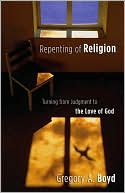
 Hi all, John here. I read the book Repenting of Religion by Gregory A Boyd while at L'Abri this past summer. Here's my review:
From the back of the book: “Gregory A. Boyd is senior pastor of Woodland Hills Church in St. Paul, Minnesota. He is the author of twelve books, including Seeing Is Believing and the best-selling, Gold Medallion Book Award winner, Letters from a Skeptic.” If you have not read Letters from a Skeptic, I would also encourage you to read that. It is a conversation of letters between Boyd and his father, who was very anti-religion and anti-Christianity. That book is truly a picture of love and grace between son and father.
Repenting of Religion should become a very influential book in our postmodern times. It is one of the more impactful books that I have read in the past year. Published in 2004, it seeks to uncover and unpack what is wrong with the church today. Boyd begins by talking about the Tree of the Knowledge of Good and Evil. His take on it is that by eating of that Tree, we are now predisposed naturally towards judging others instead of loving them. And his take is that we are in reality, as a church generally (though not overall), still trying to earn our way into Heaven (my words) by the fact that we have set up hierarchies of sin and fail to love others.
He makes the point that churches today, like in the days of the Pharisees, are mostly not a place where broken, questioning, and lost people feel safe to come. They are not places where modern day “tax collectors”, prostitutes, and drug addicts, among others, feel free to come. Instead, they go to bars, pimps, drugs, and other addicts to feel loved. Is this right? Is this loving? Why, if we are called to love others like Christ, are these people not coming in? Boyd’s answer? Because we are failing to truly love.
The church as a whole has not failed to preach the message that salvation is by grace, not by works. Generally speaking, Christians don’t try to be saved by meticulously carrying out the Old Testament law. Yet we must wonder if we have adhered to the letter of Paul’s teaching and missed its spirit (2 Cor. 3:6). For as much as we claim that our relationship with God is based totally on the work of Christ, it seems that many of us nevertheless continue to try to get life from the rightness of our beliefs and goodness of our behavior. We continue to eat of the Tree of the Knowledge of Good and Evil, which the law, leading us to Christ, was meant to abolish…The fact that the collective body of the church (my note: Notice he didn’t call it the body of Christ!) is known more for its declarations of good and evil than for its outrageous love is telling. (pg 97)
He continues a little further down,
Another evidence of our spiritual pathology is that at both an individual and corporate level Christians often lack the freedom, flexibility, joy, boldness, and playfulness of a real lover. The abundant life and reckless love Jesus exemplified and came to bring is often replaced with a hypervigilance on what people ought to believe, how people ought to behave, and how the church should appear (emphases mine). We live out of our ethical maxims and religious ideas rather than the vibrant, concrete life and love of God. We live in the abstract, not the concrete.
This next section cuts to the core of the issue:
The New Testament is not about ethical behavior; it’s about a radical new way of
living. It is about life lived in surrendered union to God through faith in Jesus Christ. It is about experiencing the transforming power of God’s love flowing into and through a person. It demands a form of holiness that is far more exacting than any ethical or religious system. It demands a holiness of the heart that does not feed the fallen self by distancing itself from sinners but rather sacrifices itself to unite with sinners. This kind of holiness can never be achieved through behavior. It has to be received by grace (emphasis mine). Jesus’ ministry and the whole New Testament undermine our ethics and religion in order to position us to humbly receive this empowering and life transforming grace.
I remember reading an excerpt from Blue Like Jazz about a tent advertised as a “Confession Tent” that was set up on a widely secular, one that was almost semi-hostile to Christianity. When people entered that tent, instead of being encouraged to confess their own sins, the humble and repentant Christians inside instead confessed their often lack of love for others, lack of love for the world, lack of love for the campus. I think this is a beautiful example of the stance that Christians need to have at this time in history, one where we are on our knees, asking forgiveness for wrongs done in the past in the name of “Christianity” or “religion” that have hurt so many in unimaginable ways.
I am simply unable to do Boyd full justice of his work in this piece of writing, but I hope you, the reader, are beginning to understand Boyd’s premise that Christians have failed to love. We all fail to love recklessly, freely, without judgment.
I agree with Boyd that we need to quit judging and start living and loving. No more Christian bubble. No more putting certain sins on more of a pedestal than others. When we do that, we look down on others because we are in effect saying “Look, I don’t do these, and you do, so I’m better than you.” That easily leads into a spirit of judgment, the antithesis of love. When we fail to love, we fail to follow Christ. It’s that simple.
We are all sinners who need God’s grace. Let us look at the person, not the sin. Let’s love the person like Christ loved the prostitutes, the tax collectors, the sinners. Let us make our churches (as important as they are) places where everyone feels welcome. Let us love recklessly, painfully, sacrificially. Let us restore Christ’s good name on this Earth by living the loving life He calls us towards.
Until next time,
John


 Posts
Posts

